 Wie lebt mein Essen?
Milk · Freedom of movement
How much room do dairy cows have?
Usual: the loose-housing barn, and in some barns the cow stands tied. The same for every label: In a tie stall, the cow is fixed by the neck and has one to two steps of room.
Why it is like this
In a tie stall the cow is fixed at the neck with one to two steps of room, can stand up and lie down, but cannot turn around. EFSA recommends at least 9 square metres of barn area per cow, plus pasture, so she can walk freely and lie comfortably. We found no legal minimum for adult cows in the German animal husbandry ordinance, only for calves. Organic gives 6 square metres inside and 4.5 outside. A cow can only run and play on a larger pasture.
What the labels say
| Standard | Level |
|---|---|
| Conventional | no fixed rule |
| Pasture milk without a label | no fixed rule |
| Pro Weideland | no fixed rule |
| Tierschutzbund entry level | 1-3 |
| Tierschutzbund premium level | 1-3 |
| Organic (EU) | no fixed rule |
| Biopark | 1-3 |
| Gäa | 1-3 |
| Bioland | 1-3 |
| Naturland | 1-3 |
| Demeter | 1-3 |
| Zeit zu zweit (cow and calf together) | 1-3 |
How we read the levels
- Stand up and lie down again.
- Turn around and stretch out its whole body.
- Walk around without getting in anyone's way.
- Run and play.
Level 1: Stand up and lie down again.
In a tie stall, the cow is fixed by the neck and has one to two steps of room. She can stand up and lie down, but cannot turn around.
The usual short stall is 1.40 to 1.80 metres long. In 2020, 11 to 12 percent of housing places for dairy cows were tie stalls. Of the farms with tie stalls, 48 percent kept the animals tied all year round, 52 percent alternated with outdoor access. There is no ban. EU organic allows tying only for farms with up to 50 animals, with a permit and outdoor access. Bioland, Naturland, Biopark and Gäa rule out year-round tying.
Level 2: Turn around and stretch out its whole body.
Possible on some farms, not guaranteed: Tierschutzbund entry level, Tierschutzbund premium level, Biopark, Gäa, Bioland, Naturland, Demeter and Zeit zu zweit (cow and calf together)
In a loose-housing barn, the cow can turn around and stretch out. Organic associations and the Tierschutzbund are at this level and above.
In loose-housing barns, cows lie in cubicles separated by metal bars. The Tierschutzbund requires 6 square metres of barn per cow at the entry level and at most 600 animals per farm. We found no legal minimum area for adult cows, as the ordinance names only calves. The EU agency EFSA recommends at least 9 square metres of barn per cow and access to pasture.
Level 3: Walk around without getting in anyone's way.
Possible on some farms, not guaranteed: Tierschutzbund entry level, Tierschutzbund premium level, Biopark, Gäa, Bioland, Naturland, Demeter and Zeit zu zweit (cow and calf together)
The cow can walk around without others standing in her way. In a loose-housing barn with an outdoor run or pasture this is possible. We place organic associations and the Tierschutzbund here.
Organic requires 6 square metres in the barn and 4.5 square metres outdoors per dairy cow. The Tierschutzbund (premium level) requires a year-round exercise yard of 3 square metres per cow. The placement at rung 3 is our reading of the area figures, as the associations say nothing about free roaming.
What stays open
There is no rule on this for adult cows, only for calves (1.5 square metres up to 150 kilograms). Loose housing is usual: 87 percent of housing places, alongside 12 percent tie stalls (2020).
Videos
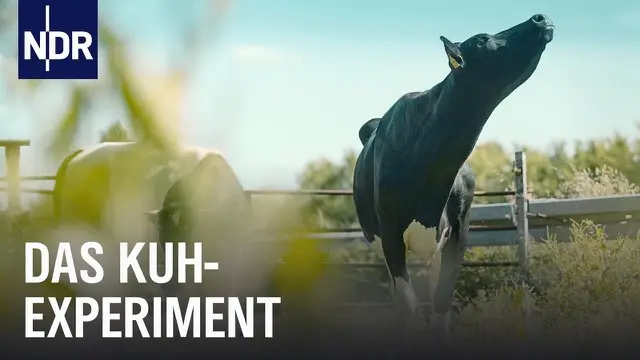 High-performance dairy cattle: how much instinct is in the cow?NDR Doku, 44 min
A high-yield cow raised indoors steps onto a pasture for the first time.
Further reading
Sources
- Albert Schweitzer Stiftung: Anbindehaltung
- Albert Schweitzer Stiftung: Milchkühe
- EU regulations 2018/848 and 2020/464
- Bioland standards 03/2026
- Naturland production standards 05/2026
- Biopark producer standards 01/2022
- Animal welfare label (Tierschutzlabel), consumer advice centre 11/2026
- German animal husbandry ordinance (legal text)
- EFSA 2023, Zusammenfassung Masthühner, gelesen
- Biopark: differences from EU organic 03/2023
- Gäa standards 03/2025
- Demeter standards 2026
- EFSA 2023: better housing for dairy cows and others
- ProVieh: fact sheet dairy cows 2023 (animal welfare organisation)
- Everything on Milk
- How long do dairy cows live?
- Are calves separated from their mothers?
- What do dairy cows lie on?
- Do dairy cows get to graze on pasture?
- Are dairy cows' horns removed?
- How long are cows transported?
- How are dairy cows slaughtered?
- Label: Tierschutzbund label
- Label: Biopark
- Label: Gäa
- Label: Bioland
- Label: Naturland
- Label: Demeter
- Label: Zeit zu zweit (cow and calf together)
- Demeter vs Bioland: Milk
- Bioland vs Naturland: Milk
- Demeter vs Naturland: Milk
- Bioland vs EU organic: Milk