 Wie lebt mein Essen?
Milk · Resting place
What do dairy cows lie on?
Usual: a cubicle with a rubber mat or little litter. The same for every label: A dry, soft lying place with straw.
Why it is like this
In a tie stall the cow lies partly on a grating, in loose housing usually in a cubicle with a rubber mat. Bioland, Gäa, Naturland and Tierschutzbund require bedded lying areas of straw. For milk, no standard places several soft spots to choose from, such as a deep-litter barn.
What the labels say
| Standard | Level |
|---|---|
| Conventional | no fixed rule |
| Pasture milk without a label | no fixed rule |
| Pro Weideland | no fixed rule |
| Tierschutzbund entry level | 3 |
| Tierschutzbund premium level | 3 |
| Organic (EU) | 3 |
| Biopark | 3 |
| Gäa | 3 |
| Bioland | 3 |
| Naturland | 3 |
| Demeter | 3 |
| Zeit zu zweit (cow and calf together) | no fixed rule |
How we read the levels
- A simple, dry, reasonably clean spot.
- A dry, clean spot that does not press or chafe.
- A dry, soft spot with straw.
- Several dry, soft spots with straw, so it can choose.
Level 3: A dry, soft spot with straw.
A dry, soft lying place with straw. Bioland, Gäa, Naturland and the Tierschutzbund require bedded lying areas, and the EU organic rule applies to every organic farm, Demeter included.
Bioland requires bedding (straw) for ruminants and does not allow fully slatted floors. Naturland bans fully slatted floors and requires at least 50 percent of the barn floor to be solid. The Tierschutzbund (both levels) requires a bedded lying area. Demeter has no sentence of its own on the lying area of cows; its standards only set the area in Annex 5 (dairy cow 6.0 m² indoors and 4.5 m² outdoors). The EU organic regulation requires solid, non-perforated lying areas with plenty of dry bedding of straw or other natural material (Annex II Part II no. 1.9.1.2), and every organic farm must keep it, Demeter included. We did not check whether tethering is allowed.
What stays open
There is no rule on this for conventional dairy cows. Cubicles with rubber mats or litter are usual.
Videos
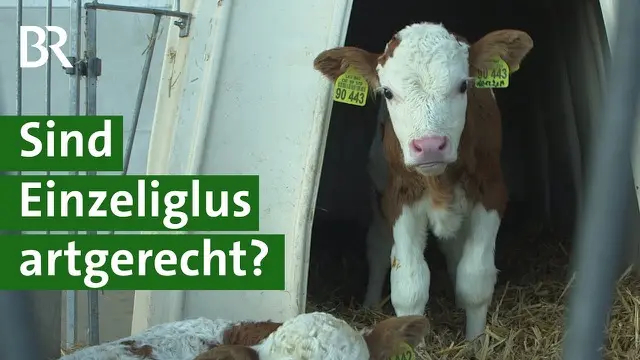 Calf mortality: is keeping calves in calf igloos appropriate for the species?Unser Land, 5 min
Calves mostly live alone in igloos. The report asks whether that suits the animals.
Further reading
Sources
- Bioland standards 03/2026
- Naturland production standards 05/2026
- Gäa standards 03/2025
- Animal welfare label (Tierschutzlabel), consumer advice centre 11/2026
- Demeter standards 2026
- EU Regulation 2018/848, Annex II Part II (husbandry: lying areas and bedding)
- ProVieh: fact sheet dairy cows 2023 (animal welfare organisation)
- Albert Schweitzer Stiftung: Milchkühe
- Everything on Milk
- How long do dairy cows live?
- Are calves separated from their mothers?
- How much room do dairy cows have?
- Do dairy cows get to graze on pasture?
- Are dairy cows' horns removed?
- How long are cows transported?
- How are dairy cows slaughtered?
- Label: Tierschutzbund label
- Label: EU organic
- Label: Biopark
- Label: Gäa
- Label: Bioland
- Label: Naturland
- Label: Demeter
- Demeter vs Bioland: Milk
- Bioland vs Naturland: Milk
- Demeter vs Naturland: Milk
- Bioland vs EU organic: Milk