 Wie lebt mein Essen?
Fish · The final trip
How long are live fish transported?
Usual: trips of live fish longer than 8 hours. Level at the front: Wild fish without a label and Wild fish with MSC label. Weakest: Naturland aquaculture and Pond farming, organic (carp, trout).
Why it is like this
Live fish may be transported for longer than 8 hours. Naturland allows up to 10 hours, and in a well boat up to 72 hours. EU organic says as short as possible, without a number of hours. Which fish really travel how long is uncertain. Wild fish do not travel alive: they die in the net or on board and arrive on land dead or dying.
What the labels say
| Standard | Level |
|---|---|
| Wild fish without a label | 4 At home on the farm or pasture, with no trip |
| Wild fish with MSC label | 4 At home on the farm or pasture, with no trip |
| Farmed salmon, conventional | no fixed rule |
| Salmon with ASC label | no fixed rule |
| EU organic aquaculture (salmon, trout) | no fixed rule |
| Naturland aquaculture | 1 After a long trip, perhaps a whole day, at a large slaughterhouse |
| Pond farming, conventional (carp, trout) | no fixed rule |
| Pond farming, organic (carp, trout) | 1 After a long trip, perhaps a whole day, at a large slaughterhouse |
How we read the levels
- After a long trip, perhaps a whole day, at a large slaughterhouse.
- After a trip of a few hours, at a slaughterhouse.
- After a short trip, at a slaughterhouse nearby.
- At home on the farm or pasture, with no trip.
Level 1: After a long trip, perhaps a whole day, at a large slaughterhouse.
Applies to: Naturland aquaculture and Pond farming, organic (carp, trout)
Live fish may be transported for more than 8 hours. Naturland allows up to 10 hours, and in a well boat (Wellboot) up to 72 hours. This is where Naturland aquaculture sits.
Naturland: at most 1 kg of fish per 8 litres of water, water change after 6 hours, carp at most 1 kg per 2 litres. For farmed salmon, the fish is pumped into a ship at about 5 kg and taken to the slaughterhouse (test.de, 2012). For farmed salmon and ASC we found no transport rule.
Level 4: At home on the farm or pasture, with no trip.
Applies to: Wild fish without a label and Wild fish with MSC label
No transport of live fish: the wild fish dies in the net or on board. It reaches land dead or dying.
Fishcount: with a trawl net, fish can spend many hours in the net, and some die before landing from crushing, suffocation or circulatory failure. Dead and dying bycatch is thrown back. Trawl nets cause 55 percent of the world's discarded bycatch, and shrimp trawls 27 percent. According to a WWF report of 2008, about a third of the catch in the North Sea goes overboard as bycatch. UNSICHER: The WWF figure is from 2008.
What stays open
There is no rule on this for farmed salmon and pond fish that we found. Transport in a well boat or tanker to the slaughterhouse is usual.
Videos
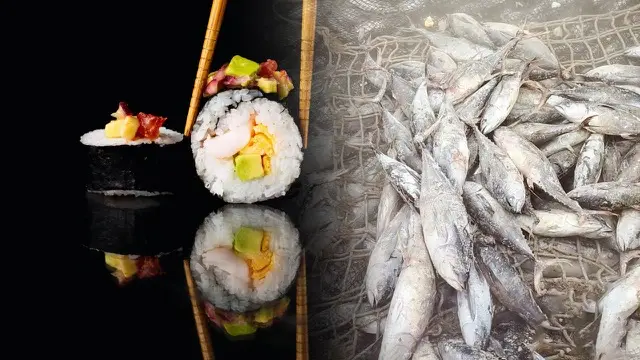 Sushi hunger: a lifestyle with downsidesSWR, 45 min
The film shows the fishing and aquaculture behind the sushi boom and its consequences.
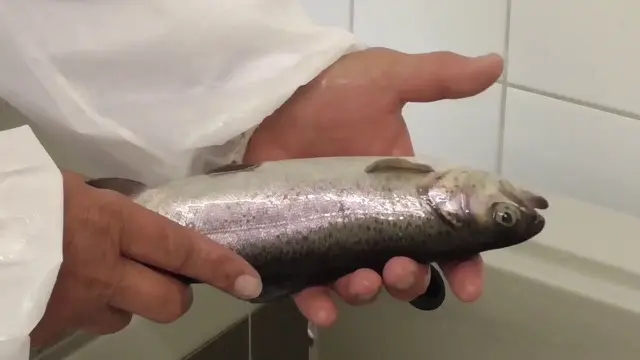 Animal welfare in fish farming: stunning and slaughtering trout humanelyBZL, Bundeszentrum für Landwirtschaft, 10 min
A federal agency shows how trout are stunned and slaughtered to keep suffering low. Partly shows distressing images.
Further reading
- Fishcount: Worse things happen at sea (summary, English) (PDF, research, may show distressing images)
- Faunalytics: Humane stunning for wild-caught fishes (English) (Article, research overview)
- Test.de: Production conditions for salmon (2012) (in German) (Article, test magazine)
Sources
- Everything on Fish
- How old are fish when they are killed for food?
- Do farmed fish ever see their parents?
- How much space do farmed fish have?
- What does a farmed fish's habitat look like?
- Do farmed fish live outdoors?
- What treatments do farmed fish get?
- How are fish killed?
- Label: Wild fish without a label
- Label: MSC (wild fish)
- Label: Naturland aquaculture
- Label: Pond farming, organic