 Wie lebt mein Essen?
Fish · Physical interventions
What treatments do farmed fish get?
Usual: treatments against parasites and disease. Level at the front: Wild fish without a label and Wild fish with MSC label. Weakest: Farmed salmon, conventional.
Why it is like this
With conventional farmed salmon, routine treatments are common, and according to the Norwegian Veterinary Institute one in four salmon dies early. EU organic, Naturland and ASC forbid routine treatments, while handling and medicines according to plan remain allowed. Wild fish are left alone until they are caught. We do not count injuries from nets and bycatch.
What the labels say
| Standard | Level |
|---|---|
| Wild fish without a label | 4 Never. The animal keeps everything it was born with |
| Wild fish with MSC label | 4 Never. The animal keeps everything it was born with |
| Farmed salmon, conventional | 1-2 level 1 guaranteed (Always, if it makes keeping the animals easier); up to level 2 depending on the farm |
| Salmon with ASC label | 2 Only if the animals might otherwise injure themselves with them |
| EU organic aquaculture (salmon, trout) | 2-3 level 2 guaranteed (Only if the animals might otherwise injure themselves with them); up to level 3 depending on the farm |
| Naturland aquaculture | 2-3 level 2 guaranteed (Only if the animals might otherwise injure themselves with them); up to level 3 depending on the farm |
| Pond farming, conventional (carp, trout) | no fixed rule |
| Pond farming, organic (carp, trout) | 2-3 level 2 guaranteed (Only if the animals might otherwise injure themselves with them); up to level 3 depending on the farm |
How we read the levels
- Always, if it makes keeping the animals easier.
- Only if the animals might otherwise injure themselves with them.
- Only if a particular animal needs treatment itself.
- Never. The animal keeps everything it was born with.
Level 1: Always, if it makes keeping the animals easier.
Applies to: Farmed salmon, conventional
Routine treatments are allowed: for conventional farmed salmon, treatments against parasites and diseases are usual. According to the Norwegian Veterinary Institute, one in four salmon dies prematurely, and one in six before reaching slaughter size.
Crowded net pens are a good breeding ground for diseases and parasites (Verbraucherzentrale Hamburg). A Foodwatch report (04.12.2024) documents severe injuries from parasites. This is Norway, not Germany. UNSICHER: Whether the Norwegian figures apply to salmon sold in Germany, we have not checked.
Level 2: Only if the animals might otherwise injure themselves with them.
Applies to: Salmon with ASC label, EU organic aquaculture (salmon, trout), Naturland aquaculture and Pond farming, organic (carp, trout)
Possible on some farms, not guaranteed: Farmed salmon, conventional
Routine treatments are banned, while handling and planned medication remain allowed: this is how it is for EU organic, Naturland and ASC.
Naturland: no preventive chemical treatments, and if more than two treatments a year or three in a lifetime are needed, the animals may no longer be sold as Naturland. ASC v1.4: all medicines only on veterinary prescription, at least four veterinary visits a year. EU organic: no preventive medicines, and handling should be kept to a minimum.
Level 3: Only if a particular animal needs treatment itself.
Possible on some farms, not guaranteed: EU organic aquaculture (salmon, trout), Naturland aquaculture and Pond farming, organic (carp, trout)
Only on a veterinarian's instruction: EU organic and Naturland come close to this with their rules, but not expressly.
The table counts 2 to 3. UNSICHER: We found fin clipping regulated in no standard.
Level 4: Never. The animal keeps everything it was born with.
Applies to: Wild fish without a label and Wild fish with MSC label
Nothing is done to the animal: this is the wild fish until it is caught. Injuries from nets and bycatch are not counted here.
This is our reading. Catching causes damage to skin and scales (Fishcount), which we do not weigh here.
What stays open
There is no rule on this for conventional pond farming that we found. Handling during harvesting, sorting and holding is usual.
Videos
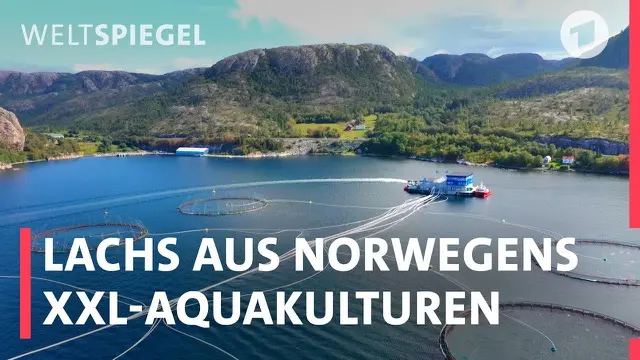 The tough business with salmonWeltspiegel, 29 min
Salmon farming in Norway: how the fish are kept and what problems arise.
Further reading
- Verbraucherzentrale Hamburg: Buying salmon, better not (in German) (Article, consumer advice centre)
- Naturland: Aquaculture guidelines (treatments) (in German) (PDF, association)
Sources
- Naturland aquaculture standards 05/2026
- ASC Salmon Standard v1.4
- EU Regulation 2018/848 aquaculture
- Fishcount
- Wild catch: the fish lives freely in the sea, lake or river until it is caught
- Verbraucherzentrale Hamburg: Fischlabel 2021
- LfL-Merkblatt Karpfenteichwirtschaft
- Everything on Fish
- How old are fish when they are killed for food?
- Do farmed fish ever see their parents?
- How much space do farmed fish have?
- What does a farmed fish's habitat look like?
- Do farmed fish live outdoors?
- How long are live fish transported?
- How are fish killed?
- Label: Wild fish without a label
- Label: MSC (wild fish)
- Label: Farmed salmon, conventional
- Label: ASC (farmed salmon)
- Label: EU organic aquaculture
- Label: Naturland aquaculture
- Label: Pond farming, organic