 Wie lebt mein Essen?
Fish · Freedom of movement
How much space do farmed fish have?
Usual: up to 25 kilograms of fish per cubic metre of water. Level at the front: Wild fish without a label and Wild fish with MSC label. Weakest: Salmon with ASC label.
Why it is like this
In Norway, farmed salmon may be kept at up to 25 kilograms per cubic metre according to test.de, so about 2.5 percent of the water is fish. An older leaflet gives the same figure for EU organic trout. Naturland allows at most 10 kilograms for salmon, 15 for char and whitefish, 20 for trout. At 10 kilograms, one hundredth of the water is fish.
What the labels say
| Standard | Level |
|---|---|
| Wild fish without a label | 4 Run and play |
| Wild fish with MSC label | 4 Run and play |
| Farmed salmon, conventional | 1-2 level 1 guaranteed (Stand up and lie down again); up to level 2 depending on the farm |
| Salmon with ASC label | 1 Stand up and lie down again |
| EU organic aquaculture (salmon, trout) | 2-3 level 2 guaranteed (Turn around and stretch out its whole body); up to level 3 depending on the farm |
| Naturland aquaculture | 3 Walk around without getting in anyone's way |
| Pond farming, conventional (carp, trout) | 3 Walk around without getting in anyone's way |
| Pond farming, organic (carp, trout) | 3-4 level 3 guaranteed (Walk around without getting in anyone's way); up to level 4 depending on the farm |
How we read the levels
- Stand up and lie down again.
- Turn around and stretch out its whole body.
- Walk around without getting in anyone's way.
- Run and play.
Level 1: Stand up and lie down again.
Applies to: Farmed salmon, conventional and Salmon with ASC label
For conventional farmed salmon, our sources give no limit. According to test.de, up to 25 kilograms of fish per cubic metre are allowed in Norway. For ASC we found no rule.
25 kg of fish in 1,000 litres of water is 1 kg of fish per 40 litres, so 2.5 percent of the water (our own calculation). One retailer gave 20 kg as its own limit, which is 5 kg below the Norwegian law (test.de, 2012). ASC: standard v1.4 has no stocking density, and the Verbraucherzentrale Hamburg writes "no information". UNSICHER: The 25 kg comes from a report of 2012.
Level 2: Turn around and stretch out its whole body.
Applies to: EU organic aquaculture (salmon, trout)
Possible on some farms, not guaranteed: Farmed salmon, conventional
Up to 25 kg per cubic metre: this is what applies to EU organic for trout (according to an older leaflet). About 2.5 percent of the water is then fish.
The figure comes from the state agency's leaflet (old EU rule). We did not find the table for the current regulation. UNSICHER.
Level 3: Walk around without getting in anyone's way.
Applies to: Naturland aquaculture, Pond farming, conventional (carp, trout) and Pond farming, organic (carp, trout)
Possible on some farms, not guaranteed: EU organic aquaculture (salmon, trout)
Up to 20 kg per cubic metre or less: Naturland allows at most 10 kg for salmon, 15 for char and whitefish, 20 for trout. At 10 kg, one hundredth of the water is fish.
For salmon in sea net pens, EU organic gives 10 kg per cubic metre (according to the Verbraucherzentrale Hamburg), and 20 kg in fresh water. In the carp pond of conventional farming, 600 to 1,000 carp per hectare are kept in the last year. "Under no circumstances may the animals have injuries from too high a density" (Naturland).
Level 4: Run and play.
Applies to: Wild fish without a label and Wild fish with MSC label
Possible on some farms, not guaranteed: Pond farming, organic (carp, trout)
A spacious pond in which at least half of the growth comes from natural food, or the open sea. This is how it is with wild catch and in the organic carp pond.
Naturland carp: at most 1,200 kg per hectare and year with protein feed, at least 50 percent of growth from natural food, no fishmeal. In the sea, the wild fish is free until it gets into the net. This is our reading, and no source states it.
What stays open
For conventional trout in a flow-through pond, we found no figure. Keeping in a pond or tank is usual.
Videos
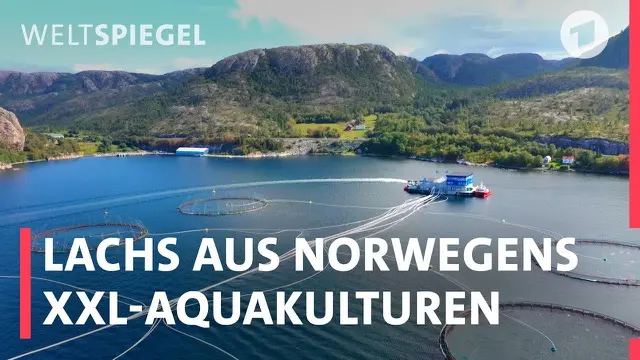 The tough business with salmonWeltspiegel, 29 min
Salmon farming in Norway: how the fish are kept and what problems arise.
 Re: Salmon crisis in NorwayARTE, 30 min
On Norwegian salmon farms many fish die from a parasite, the salmon louse.
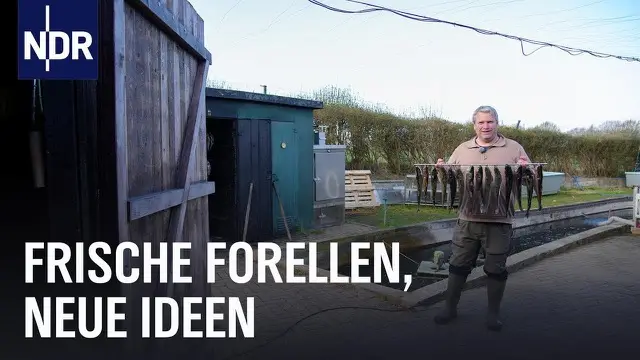 Trout farming: between pond, smokehouse and weekly marketNDR Doku, 29 min
A trout farmer in Germany shows ponds, smokehouse and sales at the market.
Further reading
- Test.de: Production conditions for salmon (2012) (in German) (Article, test magazine)
- Verbraucherzentrale Hamburg: Buying salmon, better not (in German) (Article, consumer advice centre)
- Naturland: Aquaculture guidelines (stocking densities) (in German) (PDF, association)
Sources
- ASC Salmon Standard v1.4
- Verbraucherzentrale Hamburg: Fischlabel 2021
- LfL-Merkblatt Salmoniden
- Naturland aquaculture standards 05/2026
- LfL-Merkblatt Karpfenteichwirtschaft
- Wild catch: the fish lives freely in the sea, lake or river until it is caught
- EU-Verordnung 2020/464 Besatzdichte
- Sachsen: Grundlagen Teichwirtschaft
- EU Regulation 2018/848 aquaculture
- Everything on Fish
- How old are fish when they are killed for food?
- Do farmed fish ever see their parents?
- What does a farmed fish's habitat look like?
- Do farmed fish live outdoors?
- What treatments do farmed fish get?
- How long are live fish transported?
- How are fish killed?
- Label: Wild fish without a label
- Label: MSC (wild fish)
- Label: Farmed salmon, conventional
- Label: ASC (farmed salmon)
- Label: EU organic aquaculture
- Label: Naturland aquaculture
- Label: Pond farming, conventional
- Label: Pond farming, organic