 Wie lebt mein Essen?
Eggs · Outdoors
How often are laying hens outside?
Usual: a closed barn. In 2024, 58 of 100 eggs came from floor systems. Level at the front: 9 standards, among them Free range, Tierschutzbund premium level and Neuland. Weakest: Barn eggs.
Why it is like this
In floor systems a hen never goes outside, the barn is bright but closed. Free range and organic have an outdoor run of at least 4 square metres per hen, and the hatches are open by day. Without trees, bushes or shelters the hens hardly use it. Only at Neuland, Bioland, Naturland, Demeter and Gäa do the hens decide each day whether to go out.
What the labels say
| Standard | Level |
|---|---|
| Barn eggs | 1 Never. A bright barn is enough |
| Free range | 3-4 level 3 guaranteed (On a few days a week); up to level 4 depending on the farm |
| Tierschutzbund entry level | 2 Never, but it feels fresh air in the barn |
| Tierschutzbund premium level | 3-4 level 3 guaranteed (On a few days a week); up to level 4 depending on the farm |
| Neuland | 3-4 level 3 guaranteed (On a few days a week); up to level 4 depending on the farm |
| Organic (EU) | 3-4 level 3 guaranteed (On a few days a week); up to level 4 depending on the farm |
| Biopark | 3-4 level 3 guaranteed (On a few days a week); up to level 4 depending on the farm |
| Gäa | 3-4 level 3 guaranteed (On a few days a week); up to level 4 depending on the farm |
| Bioland | 3-4 level 3 guaranteed (On a few days a week); up to level 4 depending on the farm |
| Naturland | 3-4 level 3 guaranteed (On a few days a week); up to level 4 depending on the farm |
| Demeter | 3-4 level 3 guaranteed (On a few days a week); up to level 4 depending on the farm |
How we read the levels
- Never. A bright barn is enough.
- Never, but it feels fresh air in the barn.
- On a few days a week.
- On almost every day.
Level 1: Never. A bright barn is enough.
Applies to: Barn eggs
In barn housing, a hen never goes outside. The barn is bright but closed.
Buildings put into use after 13 March 2002 need light openings of at least 3 percent of the barn floor area (§ 13 para. 3 TierSchNutztV). An outdoor run is not required. 57.6 percent of eggs come from barn housing (2025).
Level 2: Never, but it feels fresh air in the barn.
Applies to: Tierschutzbund entry level
At the Tierschutzbund (entry level) the hens stay in the barn. But they have a covered scratching area with litter (Kaltscharrraum), an area with fresh air. The eggs carry code 2 (barn housing).
Tierschutzbund entry level: Kaltscharrraum, eggs labelled as barn housing, no outdoor run.
Level 3: On a few days a week.
Applies to: Free range, Tierschutzbund premium level, Neuland, Organic (EU), Biopark, Gäa, Bioland, Naturland and Demeter
For free-range, organic and all associations, there is an outdoor run of at least 4 square metres per hen. The pop-holes are open during the day. Whether the animals go out depends on the run: without trees, bushes or shelters, they hardly use it.
Organic (EU) and Bioland: access to the outdoors for at least one third of the days of life. Free-range: outdoor run during the day. The Albert Schweitzer Stiftung writes that a poorly designed run is hardly used (2016). We did not find what percentage of hens are actually outside (UNSICHER).
Level 4: On almost every day.
Possible on some farms, not guaranteed: Free range, Tierschutzbund premium level, Neuland, Organic (EU), Biopark, Gäa, Bioland, Naturland and Demeter
At Neuland, Bioland, Naturland, Demeter and Gäa, the hens may decide each day whether to go outside. So they can see the sky on almost every day if they want.
Neuland: only husbandry with outdoor access all year, outdoor run 4 m² per animal, 2.5 m² at any time under rotation (website: daily outdoor run of their own choice, UNSICHER). Bioland: green outdoor run, log, run within a radius of 150 metres. Access on at least one third of the days of life is the lower limit for organic, and our rating lies between 3 and 4 there.
What stays open
There is no rule on how many days the run is actually used. The usual case: the pop-holes open during the day, and use depends on weather and design (UNSICHER).
Videos
 From brother rooster to barn: which egg is best for environment and hen?SWR, 17 min
Compares barn, free-range and organic eggs and what each means for the hens.
 Laying hen leak: the truth about Kaufland organic eggsZDF, 17 min
Secretly filmed material from organic laying-hen barns by an animal welfare activist, put in context by the broadcaster. Partly shows distressing images.
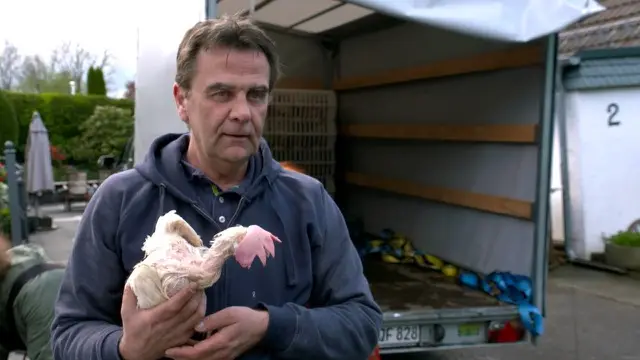 The joy of rescuing a henWDR, 44 min
A small farm takes in spent laying hens and shows how they live there.
Further reading
- ZDFheute: Which husbandry system do our eggs come from? (video, 0:25 min.) (in German) (Short video)
- Albert Schweitzer Stiftung: Laying hens (in German) (Article with many photos)
- Albert Schweitzer Stiftung: Fact sheet on laying hens (2016) (in German) (PDF, 2 pages)
Sources
- Destatis: egg production 2024 (press release)
- Animal welfare label (Tierschutzlabel), consumer advice centre 11/2026
- Albert Schweitzer Stiftung: fact sheet laying hens (animal welfare organisation)
- Albert Schweitzer Stiftung, Faktenblatt Legehennen 14.09.2016
- Bioland standards 03/2026
- EU regulations 2018/848 and 2020/464
- Neuland standards for laying hens
- Neuland website, standards
- Biopark: differences from EU organic 03/2023
- Gäa standards 03/2025
- Naturland production standards 05/2026
- Demeter standards 2026
- Everything on Eggs
- How long do laying hens live?
- Do laying hens ever see their mother?
- How much space does a laying hen have?
- Where do laying hens sleep and rest?
- Are laying hens' beaks trimmed?
- How long are laying hens transported?
- How are laying hens killed?
- Label: Barn and free-range eggs
- Label: Tierschutzbund label
- Label: Neuland
- Label: EU organic
- Label: Biopark
- Label: Gäa
- Label: Bioland
- Label: Naturland
- Label: Demeter
- Demeter vs Bioland: Eggs
- Bioland vs Naturland: Eggs
- Demeter vs Naturland: Eggs
- Neuland vs EU organic: Eggs