 Wie lebt mein Essen?
Chicken · Freedom of movement
How much space does a broiler chicken have?
Usual: about 24 chickens on one square metre. Level at the front: 7 standards, among them Tierschutzbund premium level, Neuland and Biopark. Weakest: Haltungsform 1 (indoor) and Haltungsform 2 (indoor plus space).
Why it is like this
Haltungsform 1 and 2 allow up to 39 kilograms of animal per square metre. Shortly before slaughter that is about 24 chickens on one metre by one metre: standing up and lying down work, not much more. EFSA considers even 11 kilograms too much for chickens to walk well, because more density means more foot burns. Organic allows at most 10 birds per square metre (21 kilograms), plus outdoor access. A chicken grown this fast can hardly run or play.
What the labels say
| Standard | Level |
|---|---|
| Haltungsform 1 (indoor) | 1 Stand up and lie down again |
| Haltungsform 2 (indoor plus space) | 1 Stand up and lie down again |
| Haltungsform 3 (outdoor climate) | 2 Turn around and stretch out its whole body |
| Haltungsform 4 (premium) | 2 Turn around and stretch out its whole body |
| Tierschutzbund entry level | 2 Turn around and stretch out its whole body |
| Tierschutzbund premium level | 2-3 level 2 guaranteed (Turn around and stretch out its whole body); up to level 3 depending on the farm |
| Neuland | 2-3 level 2 guaranteed (Turn around and stretch out its whole body); up to level 3 depending on the farm |
| Haltungsform 5 (organic, EU) | 2 Turn around and stretch out its whole body |
| Biopark | 2-3 level 2 guaranteed (Turn around and stretch out its whole body); up to level 3 depending on the farm |
| Gäa | 2-3 level 2 guaranteed (Turn around and stretch out its whole body); up to level 3 depending on the farm |
| Bioland | 2-3 level 2 guaranteed (Turn around and stretch out its whole body); up to level 3 depending on the farm |
| Naturland | 2-3 level 2 guaranteed (Turn around and stretch out its whole body); up to level 3 depending on the farm |
| Demeter | 2-3 level 2 guaranteed (Turn around and stretch out its whole body); up to level 3 depending on the farm |
How we read the levels
- Stand up and lie down again.
- Turn around and stretch out its whole body.
- Walk around without getting in anyone's way.
- Run and play.
Level 1: Stand up and lie down again.
Applies to: Haltungsform 1 (indoor) and Haltungsform 2 (indoor plus space)
Under Haltungsform 1 and 2, chickens stand packed close together toward the end of fattening. Up to 39 kilograms of animals per square metre are allowed, which is about 24 chickens on an area of 1 by 1 metre. Standing up and lying down is possible, but hardly much more.
The law never allows more than 39 kg/m² (§ 19 TierSchNutztV, the German animal husbandry ordinance). Averaged over three batches it is 35 kg/m² if the animals weigh under 1.6 kg on average. Planet Wissen gives up to 25 animals per square metre. EFSA writes that from 11 kg/m², foot pad inflammation increases, the ability to walk declines, and comfort and exploratory behaviour suffer. 39 kg/m² is more than three times that. According to retailers, Haltungsform 2 requires 35 kg/m² (the programme's primary text was not opened, UNSICHER). One barn holds up to 60,000 animals. According to the Albert Schweitzer Stiftung, 5 to 7 percent of the animals die before slaughter age (a figure from an animal welfare organisation, UNSICHER). In the last days the animals are heaviest and have the least space.
Level 2: Turn around and stretch out its whole body.
Applies to: Haltungsform 3 (outdoor climate), Haltungsform 4 (premium), Tierschutzbund entry level, Tierschutzbund premium level, Neuland, Haltungsform 5 (organic, EU), Biopark, Gäa, Bioland, Naturland and Demeter
Under Haltungsform 3 and 4, at the Tierschutzbund (entry level), and for organic (EU), the animals have a little more space. They can turn around and stretch. This is also guaranteed at least for Neuland and the organic associations. For organic, at most 10 animals per square metre are allowed (21 kg/m²), at the Tierschutzbund 17.
Haltungsform 3: at most 29 kg/m² and a covered outdoor climate area of at least 20 percent of the barn floor. Haltungsform 4: 25 kg/m². Organic (EU): 21 kg/m², at most 10 animals per square metre, at most 4,800 animals per compartment. Tierschutzbund entry level: 17 animals per square metre, premium 15 (Verbraucherzentrale 2026). Even 21 kg/m² is almost double the 11 kg/m² above which EFSA describes problems with walking. Neuland, Biopark, Gäa, Bioland, Naturland and Demeter: in a fixed barn, 21 kg/m² applies (Demeter 16 kg). In mobile barns the standards allow up to 30 kg/m² (Neuland in the mobile-barn pilot up to 27 kg; Neuland ch. 5, Bioland and Gäa annex 6.11.5.2, Naturland annex 5, Biopark annex B table 2, Demeter ch. 3.4.4.1 para. 4). EU organic law also knows this mobile-barn exception (not checked against the original text), and organic (EU) is at rung 2 here. So rung 2 is guaranteed at least for these six standards. Our placement at rung 2 or 3 is one reading (UNSICHER), because neither the law nor the labels say how much an animal can actually walk.
Level 3: Walk around without getting in anyone's way.
Possible on some farms, not guaranteed: Tierschutzbund premium level, Neuland, Biopark, Gäa, Bioland, Naturland and Demeter
In the fixed barns of Neuland, Bioland, Naturland, Gäa, Biopark and Demeter, the limit is 21 kilograms per square metre (Demeter 16), plus an outdoor run. The animals can move around in the barn and outside without constantly bumping into others. This applies above all in the last phase of life.
Neuland: at most 21 kg and 10 animals/m² from day 29, up to 25 kg/m² with a covered scratching area (Kaltscharrraum), outdoor run of 4 m² per chicken, at least 6 hours a day and during at least one third of their life. Bioland and Naturland: 21 kg/m², outdoor run of 4 m² per animal (fixed) or 2.5 m² (mobile), veranda of at least one third of the barn floor. Demeter (ch. 3.4.4.1): 16 kg/m² in a fixed barn (para. 2), 21 kg and at most 10 animals/m² with an outdoor climate area (para. 3), up to 30 kg and 16 animals/m² in mobile barns (para. 4). Placing this at rung 3 is our reading (L), because no text says how far animals go in practice (UNSICHER). Checked on 21 Nov 2026 in the standards themselves: Neuland (ch. 2 barn, stocking density; 4.2 covered scratching area): 21 kg and, from day 29, at most 10 animals/m² as an exclusion criterion, with a covered scratching area up to 25 kg, in the mobile-barn pilot (ch. 5) up to 27 kg and 2 m² of run. Bioland (annex 6.11.5.2), Gäa (6.11.5.2), Naturland (annex 5) and Biopark (annex B, table 2) and Demeter (ch. 3.4.4.1 para. 4, read in the 2026 standard text): up to 21 kg/m² in fixed barns (Demeter 16 kg), but up to 30 kg/m² in mobile barns. Rung 3 applies to the fixed barns of these standards. In the mobile barns (up to 30 kg/m²) the animals are only at the level of organic (EU), which is rung 2. That is why the table shows rung 2 to 3: rung 2 is guaranteed, rung 3 depends on the barn. We did not check the figures of EU organic regulation 2018/848 against the original text.
What stays open
For Tierschutzbund Premium, the summary gives no kg figure, only 15 animals per square metre and 2.5 m² of outdoor run. The usual case is a barn that is densely stocked in the last days.
Videos
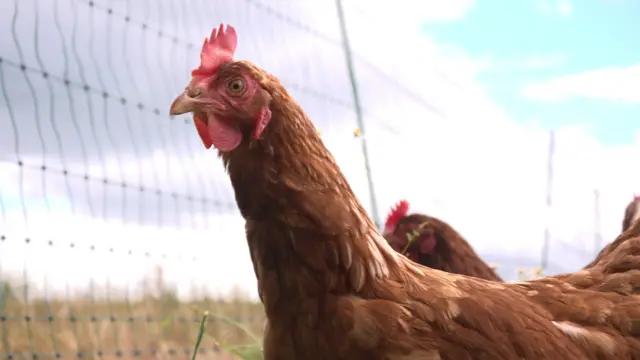 From 1,000 to 30,000 animals: protest against a chicken fattening plantSWR RLP, 5 min
Residents protest against a large chicken fattening plant in the southern Palatinate.
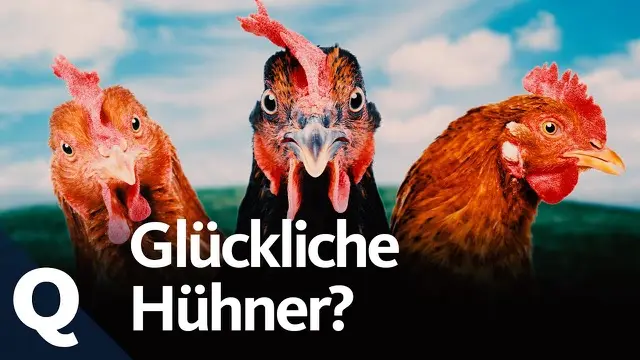 More animal welfare for chickens: what everyone can do (full episode)Quarks, 39 min
Quarks explains how chickens live and what consumers can do for better welfare.
Further reading
- Albert Schweitzer Stiftung: Broiler chickens (in German) (Article with many photos)
- Masthuhn-Initiative (in German) (Article with photos and graphics)
- EFSA: Welfare of broiler chickens (summary 2023, English) (Official agency page)
- Planet Wissen (ARD): Chickens, poultry industry (in German) (Article with photos)
Sources
- German animal husbandry ordinance (legal text)
- EFSA 2023, Zusammenfassung Masthühner, gelesen
- initiative-tierwohl.de
- Pro Weideland, consumer advice centre
- Albert Schweitzer Stiftung, Masthühner, Stand 19.02.2025, gelesen
- Haltungsform.de: guidance for broiler programmes (2025)
- EU regulations 2018/848 and 2020/464
- Animal welfare label (Tierschutzlabel), consumer advice centre 11/2026
- Verbraucherzentrale, Geflügel aus artgerechter Haltung, Stand 04.08.2026, gelesen
- Neuland standards for broiler chickens
- Bioland standards 03/2026
- Naturland production standards 05/2026
- Demeter standards 2026
- Biopark producer standards 01/2022
- Gäa standards 03/2025
- efsa.europa.eu
- Biopark: differences from EU organic 03/2023
- EFSA 2023: broiler welfare, stocking density
- Everything on Chicken
- How long does a broiler chicken live?
- Do broiler chickens grow up with their mother?
- What do broiler chickens lie on in the barn?
- Do broiler chickens go outside?
- How long are broiler chickens transported to slaughter?
- How are broiler chickens killed?
- Label: Haltungsform (husbandry level)
- Label: Tierschutzbund label
- Label: Neuland
- Label: EU organic
- Label: Biopark
- Label: Gäa
- Label: Bioland
- Label: Naturland
- Label: Demeter
- Demeter vs Bioland: Chicken
- Bioland vs Naturland: Chicken
- Demeter vs Naturland: Chicken
- EU organic vs Haltungsform 4: Chicken