 Wie lebt mein Essen?
Chicken · Resting place
What do broiler chickens lie on in the barn?
Usual: litter that stays in the barn for the whole fattening period. Level at the front: 5 standards, among them Neuland, Gäa and Bioland. Weakest: 5 standards, among them Haltungsform 1 (indoor) and Haltungsform 2 (indoor plus space).
Why it is like this
All chickens lie on litter of shavings or straw, as the law requires. It is loose, but it is not replaced during the whole fattening. At high stocking density, EFSA sees a higher risk of foot burns. Few standards offer several resting places to choose from, and Bioland adds perches or raised levels. According to LAVES Lower Saxony, the barn is usually bedded only once before the chicks arrive and not topped up regularly. The share of droppings rises, and towards the end of the fattening the chickens stand mainly on their own excrement.
What the labels say
| Standard | Level |
|---|---|
| Haltungsform 1 (indoor) | 2 A dry, clean spot that does not press or chafe |
| Haltungsform 2 (indoor plus space) | 2 A dry, clean spot that does not press or chafe |
| Haltungsform 3 (outdoor climate) | 2 A dry, clean spot that does not press or chafe |
| Haltungsform 4 (premium) | 2 A dry, clean spot that does not press or chafe |
| Tierschutzbund entry level | no fixed rule |
| Tierschutzbund premium level | no fixed rule |
| Neuland | 3 A dry, soft spot with straw |
| Haltungsform 5 (organic, EU) | 2 A dry, clean spot that does not press or chafe |
| Biopark | no fixed rule |
| Gäa | 3 A dry, soft spot with straw |
| Bioland | 3 A dry, soft spot with straw |
| Naturland | 3 A dry, soft spot with straw |
| Demeter | 3 A dry, soft spot with straw |
How we read the levels
- A simple, dry, reasonably clean spot.
- A dry, clean spot that does not press or chafe.
- A dry, soft spot with straw.
- Several dry, soft spots with straw, so it can choose.
Level 2: A dry, clean spot that does not press or chafe.
Applies to: Haltungsform 1 (indoor), Haltungsform 2 (indoor plus space), Haltungsform 3 (outdoor climate), Haltungsform 4 (premium) and Haltungsform 5 (organic, EU)
Under Haltungsform 1 to 4 and for organic (EU), the law guarantees dry, loose litter. A floor that does not press or chafe is therefore the normal case. Nothing more is required there.
§ 19 para. 1 no. 3 TierSchNutztV requires dry, loose litter for all animals at all times. The law does not say which material is used (straw, wood shavings, pellets), and that the litter is soft like straw is not proven (UNCERTAIN). According to LAVES Lower Saxony, the barn is usually bedded only once before the chicks arrive and not topped up regularly. The share of droppings rises during the fattening, and towards the end the chickens stand mainly on their own excrement. The litter is not changed during fattening (Verbraucherzentrale). Over time it becomes damp and mixed with droppings. This is one cause of foot pad inflammation. EFSA observes it more often even at densities above 11 kg/m² and recommends recording it at the slaughterhouse. That the litter stays dry for the whole fattening is a matter of practice, not of a rule.
Level 3: A dry, soft spot with straw.
Applies to: Neuland, Gäa, Bioland, Naturland and Demeter
Neuland, Bioland, Naturland, Gäa and Demeter set out litter rules of their own in their standards. Neuland requires litter on the whole floor, Demeter on two thirds of the barn floor area.
Neuland requires litter on the whole floor as an exclusion criterion. Bioland: litter, perches or raised levels and a dust bath from week 1 (standard 6.5.2). Demeter requires two thirds of the barn floor area to be bedded with material the birds can scratch in (chapter II 3.4.4.1 (6)), plus perches or raised levels. For Naturland and Gäa the table entries are taken from the standards (nl26, gae25). Here too it is not proven that the litter is soft like straw and stays dry for the whole fattening (UNCERTAIN).
What stays open
For Biopark and the Tierschutzbund we found no rule on litter. As everywhere, litter is usual, because the law requires it.
Videos
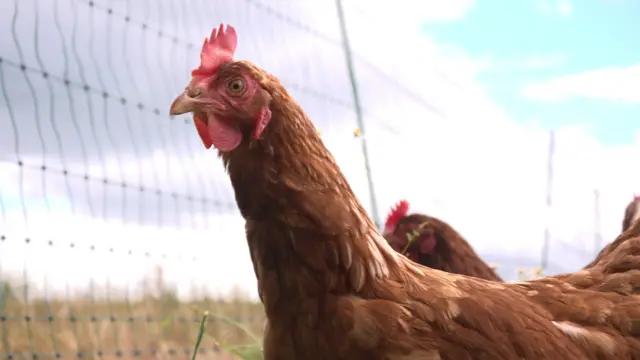 From 1,000 to 30,000 animals: protest against a chicken fattening plantSWR RLP, 5 min
Residents protest against a large chicken fattening plant in the southern Palatinate.
 More animal welfare for chickens: what everyone can do (full episode)Quarks, 39 min
Quarks explains how chickens live and what consumers can do for better welfare.
Further reading
- Albert Schweitzer Stiftung: Broiler chickens (in German) (Article with many photos)
- EFSA: Welfare of broiler chickens (summary 2023, English) (Official agency page)
- Consumer advice centre: Poultry from species-appropriate husbandry (in German) (Article)
Sources
- LAVES Lower Saxony: current problems in keeping broiler chickens
- Verbraucherzentrale, Geflügel aus artgerechter Haltung, Stand 04.08.2026, gelesen
- EFSA 2023, Zusammenfassung Masthühner, gelesen
- Neuland standards for broiler chickens
- Bioland standards 03/2026
- Demeter standards 2026
- Naturland production standards 05/2026
- Gäa standards 03/2025
- Tierschutz-Nutztierhaltungsverordnung
- EFSA 2023: broiler welfare, stocking density
- German animal husbandry ordinance (legal text)
- Everything on Chicken
- How long does a broiler chicken live?
- Do broiler chickens grow up with their mother?
- How much space does a broiler chicken have?
- Do broiler chickens go outside?
- How long are broiler chickens transported to slaughter?
- How are broiler chickens killed?
- Label: Haltungsform (husbandry level)
- Label: Neuland
- Label: EU organic
- Label: Gäa
- Label: Bioland
- Label: Naturland
- Label: Demeter
- Demeter vs Bioland: Chicken
- Bioland vs Naturland: Chicken
- Demeter vs Naturland: Chicken
- EU organic vs Haltungsform 4: Chicken