 Wie lebt mein Essen?
Pork · Outdoors
Do pigs go outside?
Usual: a barn where the pig never sees the outdoors. Furthest along: Neuland. Weakest: Haltungsform 1 (indoor).
Why it is like this
In Haltungsform 1 and 2 a bright barn is enough. Haltungsform 3 has one open barn side, Haltungsform 4 an outdoor run. Organic associations and Biopark require a run or grazing, Neuland a permanently accessible run of 0.5 square metres per pig. Only about one in a hundred fattening pigs lived under organic rules in 2021.
What the labels say
| Standard | Level |
|---|---|
| Haltungsform 1 (indoor) | 1 Never. A bright barn is enough |
| Haltungsform 2 (indoor plus space) | 1-2 level 1 guaranteed (Never. A bright barn is enough); up to level 2 depending on the farm |
| Haltungsform 3 (outdoor climate) | 2 Never, but it feels fresh air in the barn |
| Haltungsform 4 (premium) | 3-4 level 3 guaranteed (On a few days a week); up to level 4 depending on the farm |
| Tierschutzbund entry level | 2 Never, but it feels fresh air in the barn |
| Tierschutzbund premium level | 3-4 level 3 guaranteed (On a few days a week); up to level 4 depending on the farm |
| Neuland | 4 On almost every day |
| Haltungsform 5 (organic, EU) | 3-4 level 3 guaranteed (On a few days a week); up to level 4 depending on the farm |
| Biopark | 3-4 level 3 guaranteed (On a few days a week); up to level 4 depending on the farm |
| Gäa | 3-4 level 3 guaranteed (On a few days a week); up to level 4 depending on the farm |
| Bioland | 3-4 level 3 guaranteed (On a few days a week); up to level 4 depending on the farm |
| Naturland | 3-4 level 3 guaranteed (On a few days a week); up to level 4 depending on the farm |
| Demeter | 3-4 level 3 guaranteed (On a few days a week); up to level 4 depending on the farm |
How we read the levels
- Never. A bright barn is enough.
- Never, but it feels fresh air in the barn.
- On a few days a week.
- On almost every day.
Level 1: Never. A bright barn is enough.
Applies to: Haltungsform 1 (indoor) and Haltungsform 2 (indoor plus space)
The pig never sees the outdoors. A bright barn is enough. This is the case in HF1 and HF2.
In HF1, according to Annex 4, there is no access to the outdoors. HF2 allows an outdoor run as an option. According to ProVieh, most sows do not know sun, rain and snow.
Level 2: Never, but it feels fresh air in the barn.
Applies to: Haltungsform 3 (outdoor climate) and Tierschutzbund entry level
Possible on some farms, not guaranteed: Haltungsform 2 (indoor plus space)
Never outside, but fresh air in the barn: this is the outdoor climate barn in HF3, with one side of the barn open. At the Tierschutzbund entry level, at least half of one barn side is open.
The pig feels wind and cold, but has no outdoor run. At HF3 there is outdoor climate in every pen or an outdoor run. UNSICHER: The table counts HF3 as 2, although a run is possible.
Level 3: On a few days a week.
Applies to: Haltungsform 4 (premium), Tierschutzbund premium level, Haltungsform 5 (organic, EU), Biopark, Gäa, Bioland, Naturland and Demeter
Outside on some days: the organic associations and Biopark require an outdoor run or pasture access. How many days a year is not stated in the rules we read.
Organic (EU) requires an outdoor run of 0.8 m² at 50 to 85 kg, up to 1.2 m² at over 110 kg. The run is usually a paved area, not a meadow. UNSICHER: We do not know how many organic pigs go out on which days.
Level 4: On almost every day.
Applies to: Neuland
Possible on some farms, not guaranteed: Haltungsform 4 (premium), Tierschutzbund premium level, Haltungsform 5 (organic, EU), Biopark, Gäa, Bioland, Naturland and Demeter
Outside on almost every day: at Neuland, the paved outdoor run is permanently accessible. It is 0.5 m² per pig, and 0.8 m² at over 120 kg.
The pig goes out by itself and sees the sky, but this is not a pasture with ground to root in. UNSICHER: Organic farms with a permanent run (table 3-4) could also reach this rung, but the rules do not say so expressly.
What stays open
There is no figure on this for the Tierschutzbund entry level. A closed barn is usual in fattening.
Videos
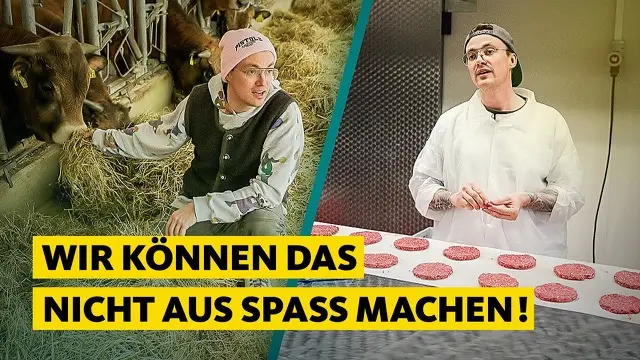 Organic meat: Mark bets on animal welfare and risks everythingQuarks, 16 min
A butcher and hunter keeps organic cattle and pigs with more space and risks a lot for it.
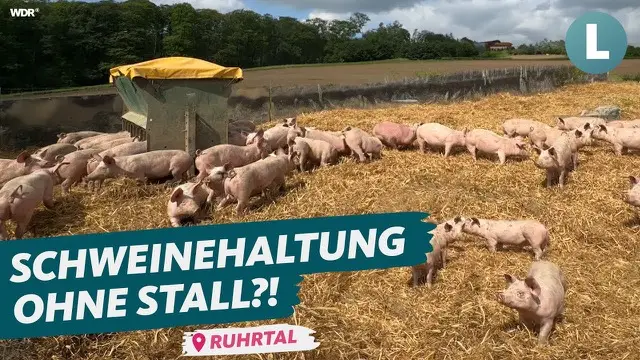 Mass pig farming outdoors: how does that work?WDR Lokalzeit Land.Schafft., 8 min
A farmer keeps 2,000 pigs outdoors on a meadow.
Further reading
- ZDF: Hannes Jaenicke, Standing up for the pig (in German) (Video, ZDF)
- Öko-Test: Pig keeping, the situation of the animals (in German) (Article, test magazine)
- Law: Annex 4 Haltungsform labelling (outdoor run per level) (in German) (Legal text)
Sources
- gesetze-im-internet.de
- provieh.de
- Animal welfare label (Tierschutzlabel), consumer advice centre 11/2026
- EU-Verordnung 2020/464 Besatzdichte
- Bioland standards 03/2026
- Biopark producer standards 01/2022
- Neuland standards for pigs
- EU regulations 2018/848 and 2020/464
- Gäa standards 03/2025
- Naturland production standards 05/2026
- Demeter standards 2026
- Thünen Working Paper 259: tail docking in pigs
- German animal husbandry ordinance (legal text)
- Everything on Pork
- How long do fattening pigs live?
- How long do piglets stay with the sow?
- How much space does a fattening pig have?
- What do pigs lie on in the barn?
- Are pigs' tails docked?
- How long are pigs transported?
- How are pigs slaughtered?
- Label: Haltungsform (husbandry level)
- Label: Tierschutzbund label
- Label: Neuland
- Label: EU organic
- Label: Biopark
- Label: Gäa
- Label: Bioland
- Label: Naturland
- Label: Demeter
- Demeter vs Bioland: Pork
- Bioland vs Naturland: Pork
- Demeter vs Naturland: Pork
- EU organic vs Haltungsform 4: Pork