 Wie lebt mein Essen?
Beef · Outdoors
Do beef cattle get out to pasture?
Usual: a barn where the bull never goes outside. Level at the front: Tierschutzbund premium level, Neuland and Pasture shot (organic beef, killed on the pasture). Weakest: Conventional and Tierschutzbund entry level.
Why it is like this
In conventional bull fattening he is usually not let outdoors. Organic requires pasture whenever weather and ground allow, and final fattening in the barn may last at most one fifth of life or three months. Imported beef can come from feedlots, where animals spend the last three to four months with thousands of others.
What the labels say
| Standard | Level |
|---|---|
| Conventional | 1-3 level 1 guaranteed (Never. A bright barn is enough); up to level 3 depending on the farm |
| Tierschutzbund entry level | 2 Never, but it feels fresh air in the barn |
| Tierschutzbund premium level | 4 On almost every day |
| Neuland | 4 On almost every day |
| Organic (EU) | 3-4 level 3 guaranteed (On a few days a week); up to level 4 depending on the farm |
| Biopark | 3-4 level 3 guaranteed (On a few days a week); up to level 4 depending on the farm |
| Gäa | 3-4 level 3 guaranteed (On a few days a week); up to level 4 depending on the farm |
| Bioland | 3-4 level 3 guaranteed (On a few days a week); up to level 4 depending on the farm |
| Naturland | 3-4 level 3 guaranteed (On a few days a week); up to level 4 depending on the farm |
| Demeter | 3-4 level 3 guaranteed (On a few days a week); up to level 4 depending on the farm |
| Pasture shot (organic beef, killed on the pasture) | 4 On almost every day |
How we read the levels
- Never. A bright barn is enough.
- Never, but it feels fresh air in the barn.
- On a few days a week.
- On almost every day.
Level 1: Never. A bright barn is enough.
Applies to: Conventional
The bull never goes outside. In conventional bull fattening, it is mostly not let outdoors.
For imported beef from South America or the USA, many cattle spend the last three to four months in a feedlot: a few thousand to 100,000 animals, under open sky, without pasture, fed on grain and soy. The Haltungsform does not have to appear on meat. The terms "Weiderind" and "Weidehaltung" (pasture beef, pasture keeping) are not protected.
Level 2: Never, but it feels fresh air in the barn.
Applies to: Tierschutzbund entry level
Possible on some farms, not guaranteed: Conventional
The animal stays in the barn and feels fresh air. The Tierschutzbund (entry level) requires an outdoor climate barn.
An outdoor climate barn means open sides, but no pasture access. This is the entry level of the Tierschutzbund.
Level 3: On a few days a week.
Applies to: Organic (EU), Biopark, Gäa, Bioland, Naturland and Demeter
Possible on some farms, not guaranteed: Conventional
The animal goes outside on some days of the year. Organic requires pasture whenever weather and soil allow it. Finishing in the barn is allowed for at most one fifth of the animal's life or three months.
Under organic rules, the animal has constant access to an outdoor run when the weather allows. Feedlots and high concentrate feed rations are excluded under organic rules.
Level 4: On almost every day.
Applies to: Tierschutzbund premium level, Neuland and Pasture shot (organic beef, killed on the pasture)
Possible on some farms, not guaranteed: Organic (EU), Biopark, Gäa, Bioland, Naturland and Demeter
The animal goes outside on almost every day. Neuland, the Tierschutzbund (premium) and the organic associations are at 3 to 4, pasture shooting at 4.
Neuland requires at least 120 days of pasture a year and constant access to an exercise yard or pasture. The Tierschutzbund (premium) requires an exercise yard all year from the 4th month of life. Cattle for pasture shooting live outdoors all year.
What stays open
There is no fixed rule for conventional beef. The usual case: 34 percent of cattle had pasture access in 2020, 6.4 months on average, bulls mostly not.
Videos
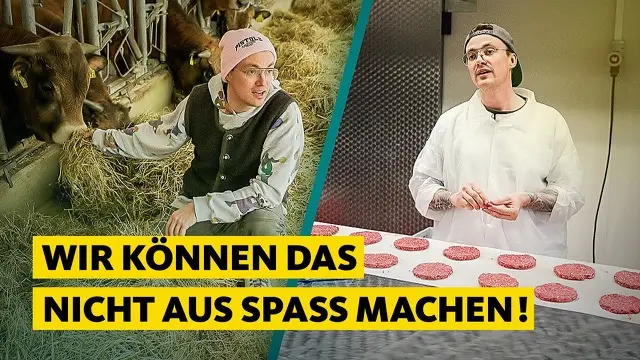 Organic meat: Mark bets on animal welfare and risks everythingQuarks, 16 min
A butcher and hunter keeps organic cattle and pigs with more space and risks a lot for it.
Further reading
Sources
- Albert Schweitzer Stiftung: Mastrinder
- Consumer advice centre: pasture milk, how much pasture is in it?
- Animal welfare label (Tierschutzlabel), consumer advice centre 11/2026
- EU regulations 2018/848 and 2020/464
- Bioland standards 03/2026
- Neuland standards for cattle
- vetmed.uni-leipzig.de
- Biopark producer standards 01/2022
- Gäa standards 03/2025
- Naturland production standards 05/2026
- Demeter standards 2026
- Everything on Beef
- How long do beef bulls live?
- How long do calves stay with their mother?
- How much space does a fattening bull have?
- What do beef cattle lie on?
- Are cattle dehorned?
- How long are cattle transported to slaughter?
- How are cattle slaughtered?
- Label: Conventional farming
- Label: Tierschutzbund label
- Label: Neuland
- Label: EU organic
- Label: Biopark
- Label: Gäa
- Label: Bioland
- Label: Naturland
- Label: Demeter
- Label: Weideschuss (organic beef, killed on pasture)
- Demeter vs Bioland: Beef
- Bioland vs Naturland: Beef
- Demeter vs Naturland: Beef
- Neuland vs EU organic: Beef